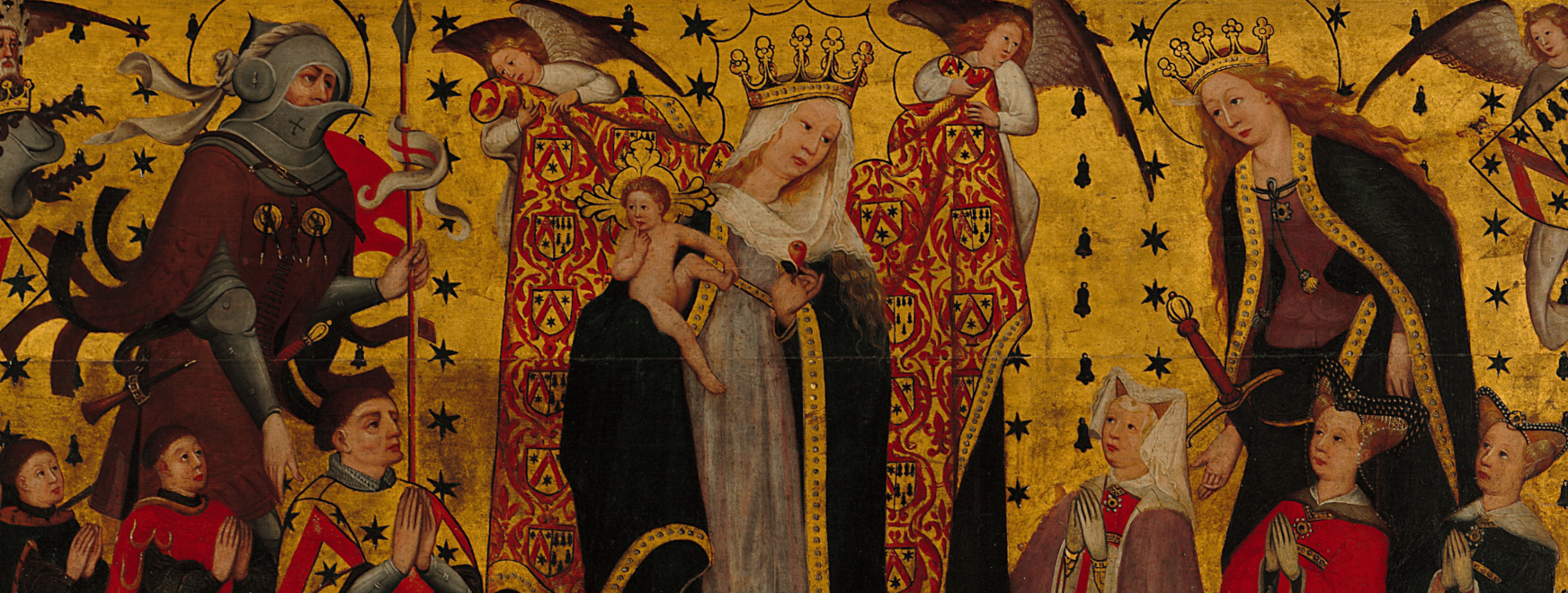
Memorial scene of Yolente Belle
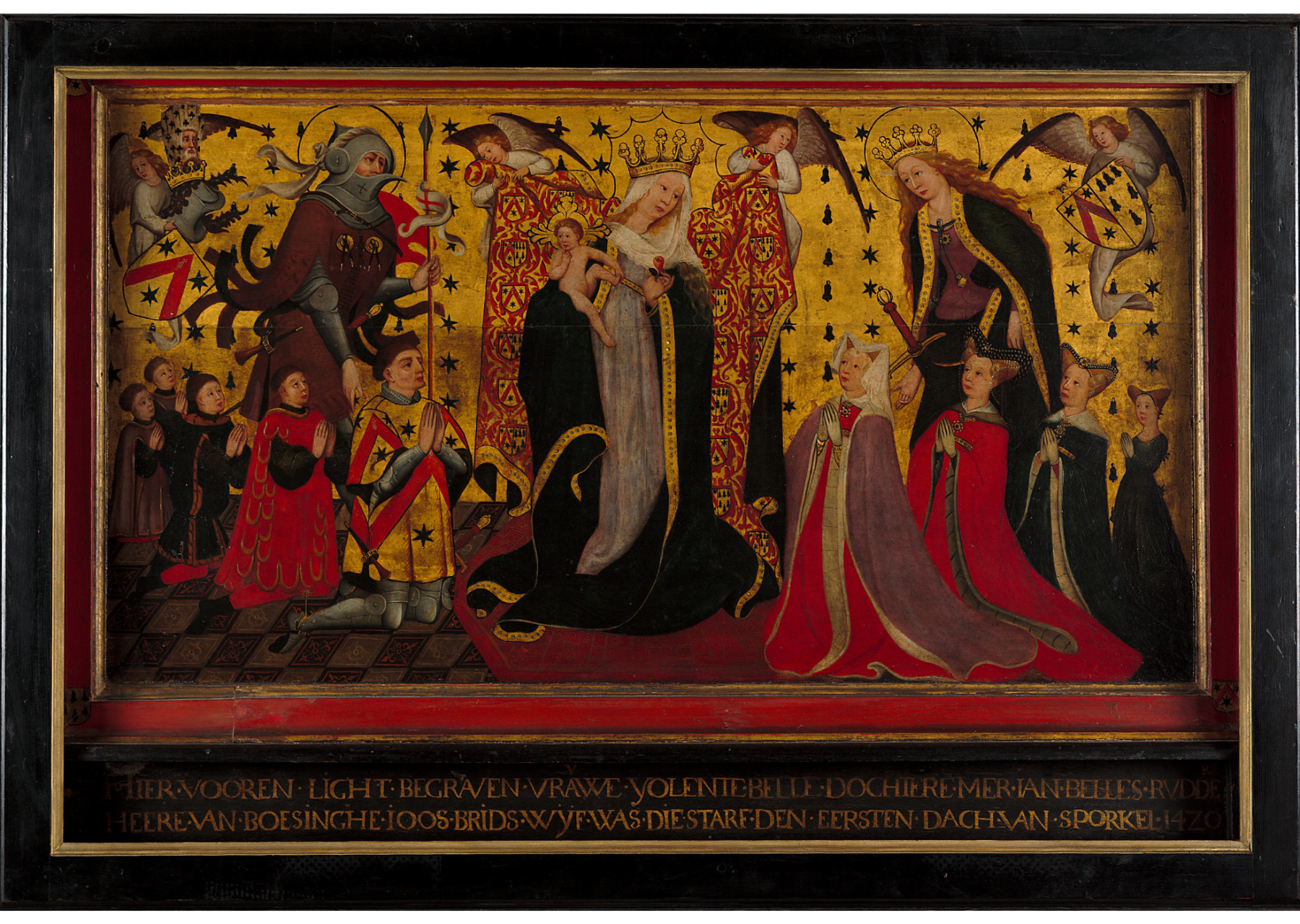
One of the absolute masterpieces in the collection of the Ypres Museum is the memorial scene by Yolente Belle. The Belle family home occupies an important place in this panel with its fascinating history.
A memorial scene
The painting is a memorial scene, intended to keep the memory of the dead alive. At the centre is a crowned Virgin Mary. The baby Jesus sits on her left arm and she holds the fruit of paradise in her right hand. This symbolises the defeat of sin. Behind Mary, two angels hold up a robe of honour. To the left and right of Mary, a couple kneels in prayer. Behind them sit their children, also in a prayerful posture. The spouses are accompanied by their patron saints: Saint George and Saint Catherine. In the two upper corners, two angels hold the couple's coats of arms.
There is a text at the bottom of the frame. It reads: “Here lies buried, Lady Yolente Belle, daughter of Jan Belles, lord of Boesinghe, wife of Joos Bryde, who died on the first day of March 1420.” From this inscription, we learn the names of the people depicted: Yolente Belle and Joos Bryde. The date of Yolente Belle's death, 1 February 1420, is also mentioned. Joos Bryde was apparently still alive in 1420, as his date of death is missing. The text also makes it clear that the painting hung near the tombstone of Yolente Belle. We know that she was buried in the chapel of the Bellegodshuis.
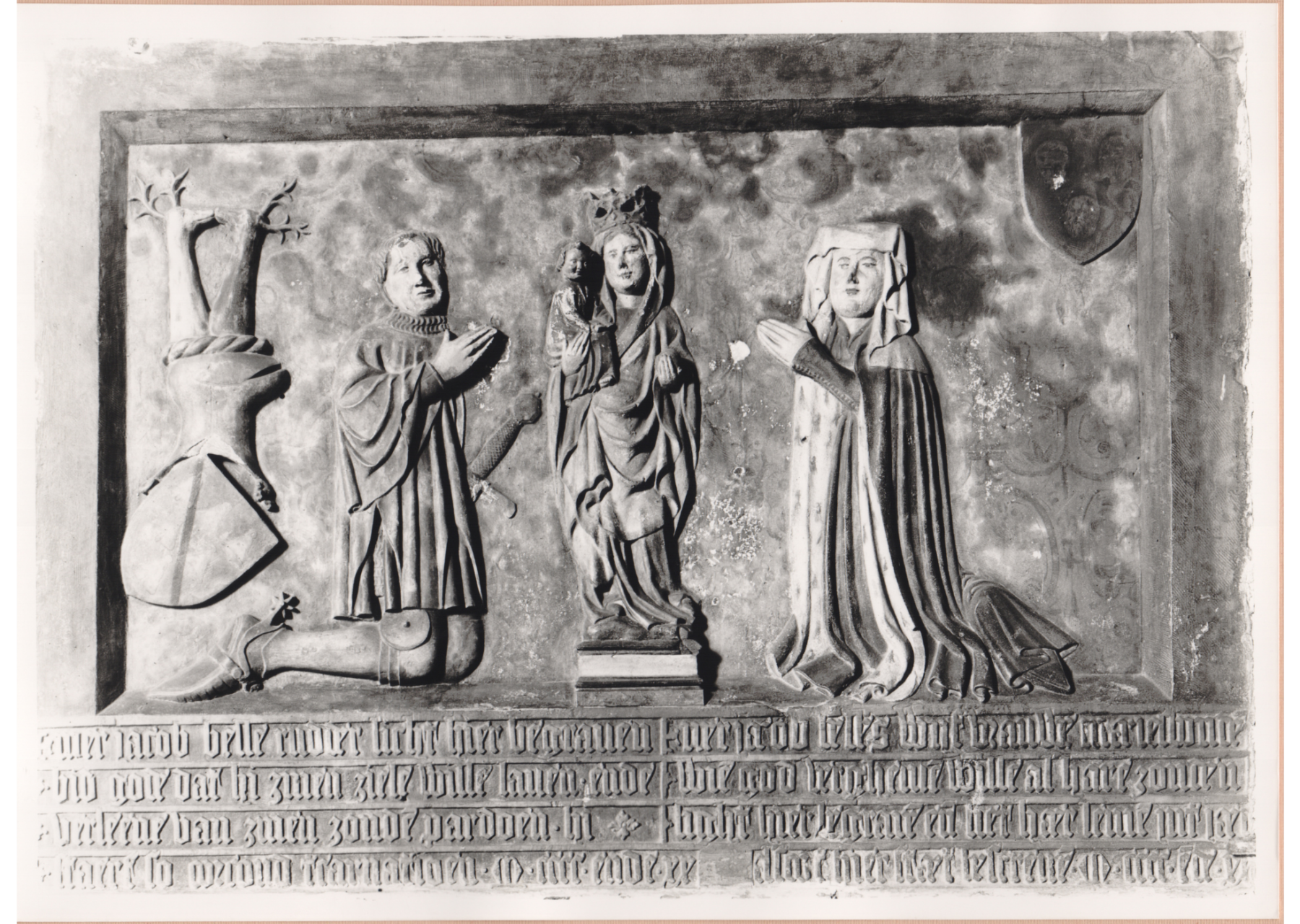
The painting is a classic representation of a memorial scene. A similar representation, this time in stone, can be found in the same chapel. The arrangement is almost identical: the couple is seated to the left and right of Marie. Here, they are Jacob Belle and Marie le Blonde. The original from 1424 has been lost, but fortunately we still have a photograph. (see below)
The chapel of the Bellegodshuis
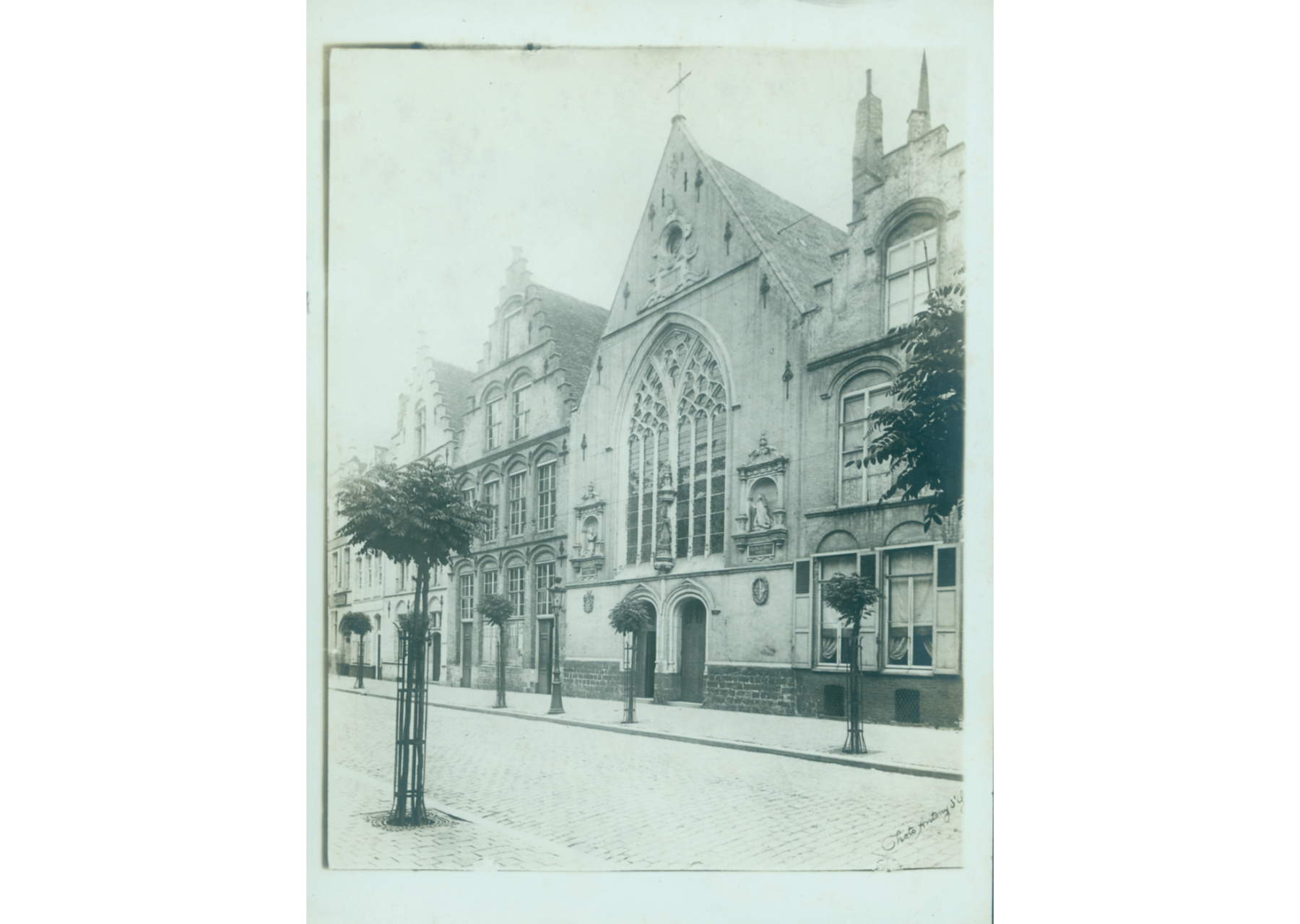
The Bellegodshuis was founded shortly before 1276 by Solomon Belle and Christina de Guines. It is one of the two large hospitals in medieval Ypres. The other hospital, the Onze-Lieve-Vrouwhospitaal, was located on the Grote Markt. The Bellegodshuis took in the sick, who were given food and lodging during their illness.
The Belle family remained closely connected to the almshouse. It was the only almshouse in Ypres where the administrators were appointed by the family rather than the city council. This led to tensions with the city council, but the family managed to retain this privilege until the French Revolution. Because of their close ties, various members of the family donated money to the almshouse during their lifetime. They also chose the chapel as their final resting place, just like Yolente Belle in 1420.
Renovation in 1616
The panel painting in our collection is not the original from 1420. It is a later copy. Doubts about the painting's date arose as early as the 1980s. In 2024, the Ypres Museum commissioned the Royal Institute for Cultural Heritage (KIK) to carry out a dating investigation. This revealed that the wood of the panels on which the painting was made was cut between 1480 and 1640.
This dating is no coincidence. At the beginning of the 17th century, the almshouse built a new chapel. The foundation stone was laid on 8 June 1616, not coincidentally a few decades after the religious turmoil. The iconoclastic fury and subsequent war destroyed much of the artistic heritage. So there was quite a bit to restore. Apparently, the almshouse took the opportunity to renew the painting as well. Had the original been lost in the iconoclasm? Or was it too damaged after 200 years to hang in the new chapel?
It is not unusual for commemorative scenes to be updated or replaced. For the heirs, they retain their function: to display the wealth of their family and call the living to pray for their ancestors. Even after 200 years, this was still so important that a new copy was made. The painting in Ypres is certainly not exceptional in this respect. There are other known examples.
What is exceptional, however, is that the painting is entirely in the style of the 15th century. The copy must therefore have been made almost entirely based on the original. The façade of the almshouse clearly shows that people in the 17th century did not shy away from giving their ancestors a new look. It depicts both founders, Salomon Belle and Christine de Guines. However, they are not wearing medieval clothing, but fashionable 17th-century attire, complete with white millstone collars.
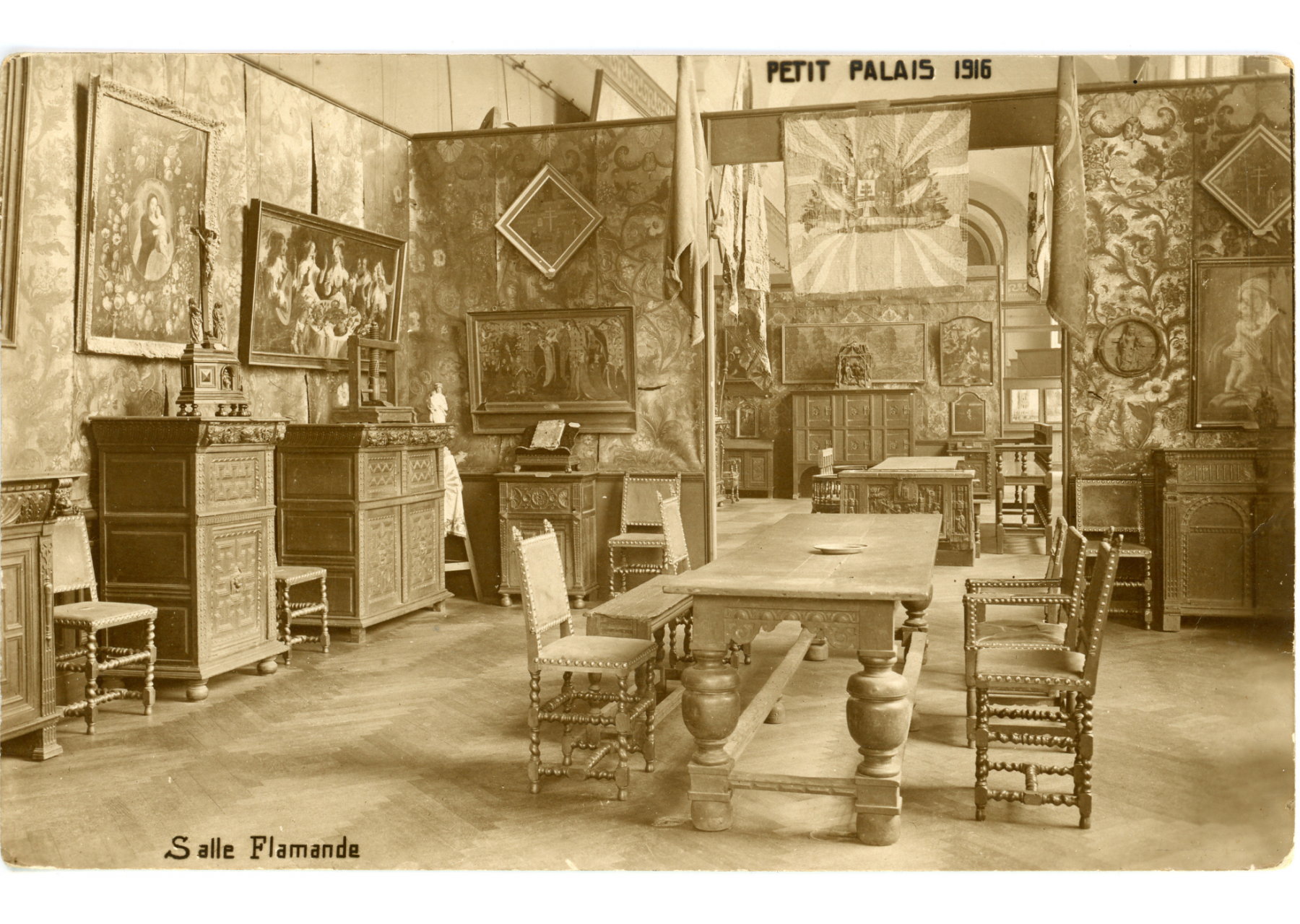
The painting remained safely in the chapel until the outbreak of the First World War. Together with other art treasures from Ypres, it was transported to Paris in 1914. There it was exhibited in the Petit Palais (see photo below). This evacuation proved necessary, as the chapel was completely destroyed during the First World War.
After the war, the painting returned to Ypres, where it was displayed in the rebuilt Godshuis Belle. Since 2018, it can be admired in the Ypres Museum in the Cloth Hall. And so, one painting sums up 600 years of city history.